

What a Better Laundry Room Needs to Solve
Most laundry rooms fail in the same three ways. Clean clothes stall in piles on the counter because nobody has a landing spot. Detergent, stain sticks, dryer sheets, and household cleaners get shuffled into one crowded cabinet. And the things you actually reach for daily end up behind the things you use twice a year.
Custom storage fixes those problems by changing three specific behaviors: access, sorting, and clutter control. Access means the detergent sits at eye level, not on a top shelf behind the vacuum bags. Sorting means each person — or each load type — has a dedicated container instead of a shared heap. Clutter control means the counter stays clear because everything on it has somewhere else to live.
That’s worth real time. Closets by Design cites an average of about 16 minutes a day spent on laundry, or nearly eight hours a month — much of it spent hunting and re-sorting.
The rest of this guide covers the three moves that do the heavy lifting: where to place shelves, how pull-out baskets change sorting, and how to plan around your household’s actual routine. For laundry room storage in Orange County, that usually means fitting shared family habits into a narrow utility space.
How Shelf Placement Changes Daily Laundry Use
Height decides how often a shelf actually gets used. The band between roughly chest and eye level is prime real estate, so it should hold what you touch every load: detergent, stain remover, dryer sheets, and the sorting bins that catch socks and delicates. When those items sit within arm’s reach of the washer, you stop setting them down on the counter “just for now” — which is how folding surfaces disappear.
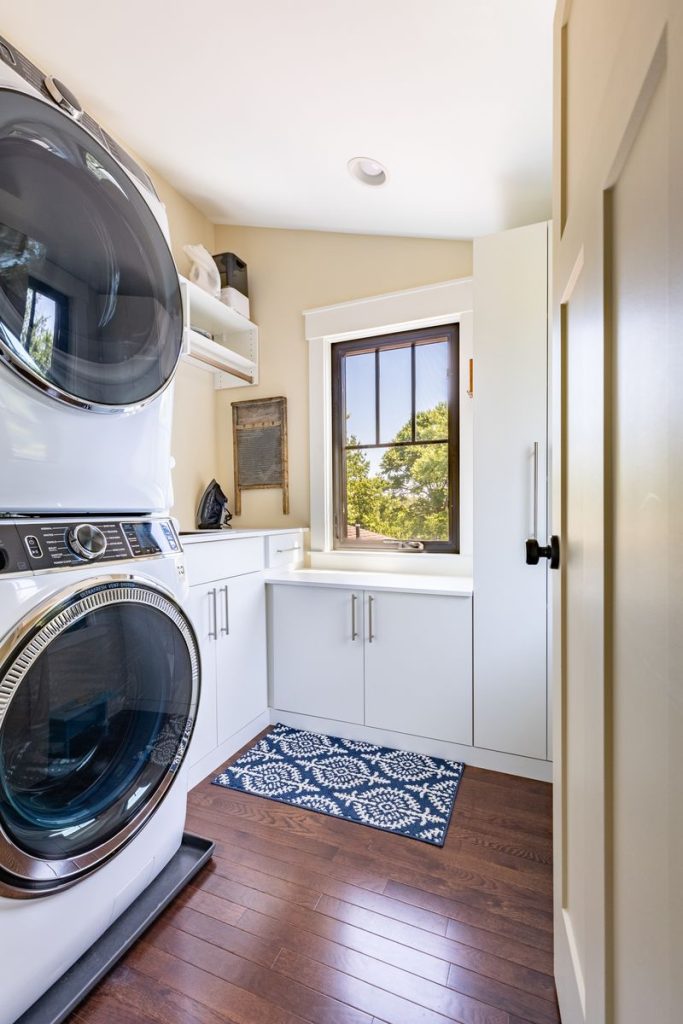
Anything above that line works best for backups and low-frequency items: the warehouse-size detergent, overflow linens, guest towels, seasonal bedding. You reach for them monthly, not daily, so a step stool is a fair trade.
Below the counter is where hampers, rolling baskets, and stacks of folded laundry belong. Keeping bulky items low frees the work surface and cuts down on the deep bending and blind searching that make a small room feel cramped.
Spacing matters as much as height. A household storing tall bottles and a vacuum needs different vertical clearance than one storing flat linens and small bins, and adjustable shelving lets that mix change as kids grow. Good laundry room storage in Orange County homes starts with measuring what you own, not copying a showroom layout.
What Pull-Out Baskets Do That Open Shelves Cannot
An open shelf asks you to lift and restack. A pull-out basket lets you slide the whole contents forward, look down into it, and take what you need — no unloading a tower of towels to reach the one at the bottom. That single difference changes how a busy laundry room feels day to day.
The bigger gain is sorting. Assign one basket per person, or split them by load type — whites, darks, delicates, linens — and sorting happens as clothes are dropped in rather than as a separate chore later. Kids can reach a low basket to drop dirty clothes or collect their folded stack without help, which keeps clean laundry moving out of the room instead of settling on the counter. Loose items that usually sprawl across a shelf, like dryer sheets, stain sticks, and stray socks, stay contained in a defined bin.
The tradeoff is real: baskets need clearance to extend, they consume more vertical space than a flat shelf, and too many of them in a narrow room will crowd your folding surface. A mix usually works best — a few pull-outs sized around your actual routine, plus adjustable shelving above for bulk supplies you touch once a month.
A Before-and-After Example of a Family Laundry Room
Picture a typical four-person household’s laundry room. Before: a jug of detergent and a bulk box of pods sit on the floor beside the washer because nothing above them fits. One wire shelf holds everything at once — dryer sheets, stain spray, spare light bulbs, a half-empty bottle of bleach pushed to the back. A single hamper near the door has quietly become the catchall for clean towels, mismatched socks, and the shoes someone kicked off. Folding happens on the dryer lid, so a running load means the pile moves to the couch.
After: adjustable shelves are set at working height for the products used every week, with backups and rarely touched utility items stored on a higher shelf out of small hands’ reach. Overflow linens get a dedicated section instead of competing with detergent. Pull-out baskets slide forward on full-extension glides so the back is visible without unloading the front, and each one is assigned — one per person for folded clothes, one for whites, one for items that need mending.
The workflow shifts. Instead of sorting on the floor and searching for supplies, the routine becomes load, fold on a counter, drop into the right basket, and let each family member carry their own. It is a practical reset, not a showroom remodel — the kind of laundry room storage many Orange County homes gain from a few well-placed changes.
How Better Storage Improves Workflow and Household Organization
Most of the time spent on laundry isn’t washing; it’s hunting for stain remover behind a stack of towels, or shuffling baskets to reach the dryer. Layout is what trims those minutes.
A workable sequence puts detergent and pretreatment at eye level near the washer, folding surface between the machines and the door, and pull-out baskets low enough for kids to reach. Shelves set at the height of the task they serve mean fewer bends, fewer trips, and no digging.
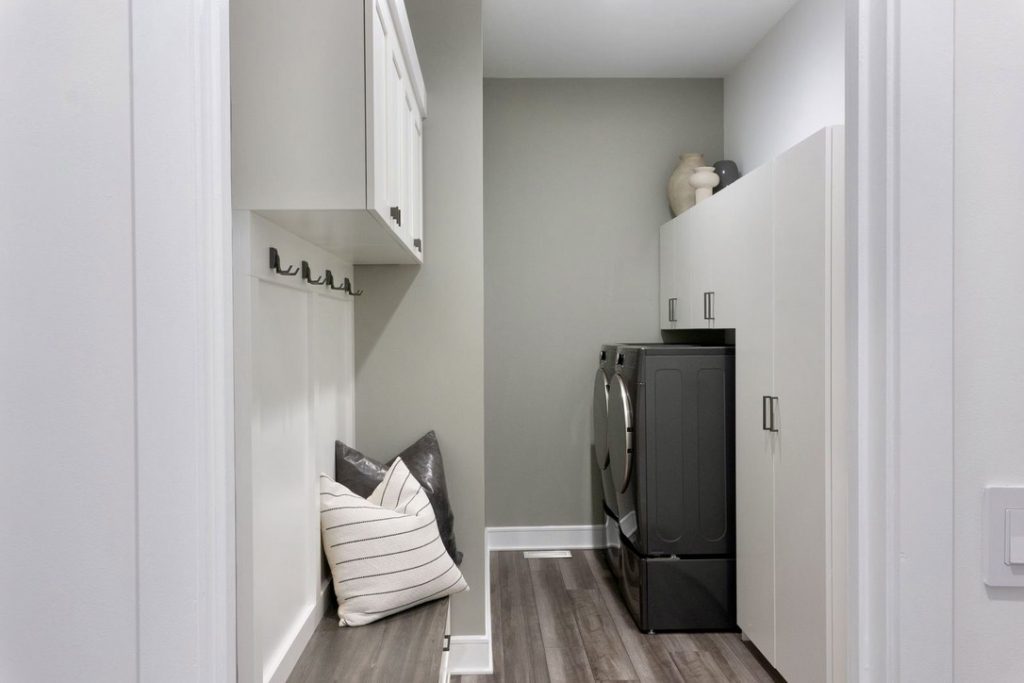
Pull-out baskets also solve the sorting problem. Instead of one pile that has to be re-sorted twice, assign a basket per person, or split by darks, whites, and delicates. Clean loads go straight into the right basket, and family members collect their own — the room does the sorting as the work happens.
Deeper closed storage absorbs the overflow that otherwise migrates: spare linens, bulk cleaning products, light bulbs, pet supplies. Kept here, they stop colonizing hall closets and garage shelves.
Because laundry rooms in Orange County homes often sit along the path from the garage, the space works best when planned alongside adjacent mudrooms and utility closet storage — shared zones, consistent shelf depths, one system rather than three.
What Orange County Homeowners Should Look for in Laundry Room Storage
Laundry rooms here rarely do only one job. Many sit between the garage and the kitchen, so they absorb cleaning supplies, pet gear, shoes, and overflow linens alongside the wash. That double duty is the reason a stock cabinet run often disappoints — the layout has to match the traffic pattern, not just the wall length.
When comparing quotes for laundry room storage in Orange County, look at the same feature set across bids: adjustable shelving, soft-close drawers, tilt-out hampers, pull-out baskets, and a folding counter deep enough to actually fold on. Cabinets Plus, for example, lists tilt-out hampers, pull-out ironing boards, and built-in folding counters among its Irvine-built cabinetry options, and several local firms offer a design consultation with layout drawings before anything is built.
Use that drawing to check the real questions: Can the hamper open with the dryer door down? Does a basket clear the doorway swing? Added features only pay off when the plan reflects how your household already moves through the room.
Laundry Room Storage FAQ
Are pull-out baskets worth it for sorting? Yes — one basket per person, or per load type, removes the sorting step entirely. Clothes go straight into the right bin, and each family member pulls their own out on laundry day. Dedicating baskets to whites, colors, or towels works the same way.
How high should shelves go? Keep detergent, stain treatment, and dryer sheets at eye level above the machines. Backup supplies, seasonal linens, and bulk purchases belong on higher shelves you reach a few times a month.
When is open shelving enough? Open shelves work for items you use daily and want to see. Once you’re storing cleaning supplies, small tools, or anything with kids around, closed drawers and baskets keep the room usable.
Do these features help in small rooms? Often more. In a compact space, vertical shelving and pull-outs recover depth you can’t otherwise reach — which is why laundry room storage in Orange County homes so often starts with a narrow closet.
For laundry room storage in Orange County, contact The Tailored Closet of Orange County. To see more laundry room make overs, click here>>